British Soldiers Lichen
(Cladonia cristatella)
Species Description
Description
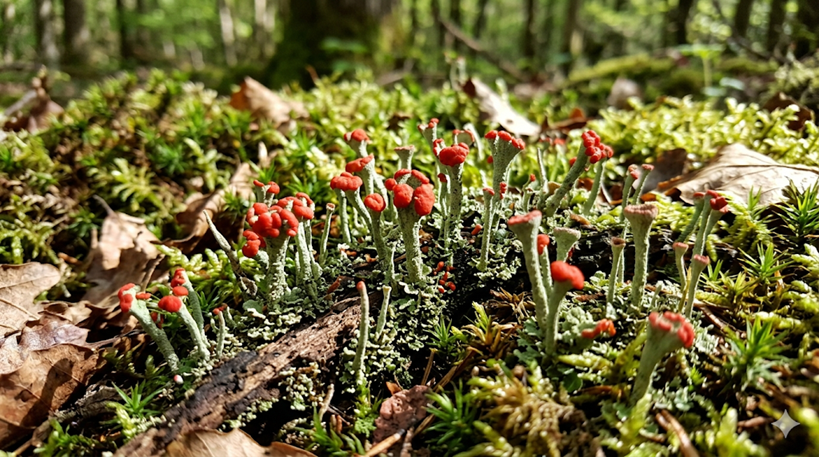
British Soldiers are one of the most recognizable and charming lichens in the forest. They look like tiny, pale green stalks topped with brilliant, waxy red caps. Their common name comes from the resemblance of these red tips to the bright red "redcoat" uniforms worn by British soldiers during the Revolutionary War.
Habitat in the ANF
In the Allegheny National Forest, British Soldiers are "pioneer" organisms. You will find them growing in nutrient-poor areas where other plants struggle, such as decaying wood, old stumps, and sandy or thin soils. They are particularly common along trail edges and in sunny clearings where they can cling to rotting logs or mossy banks. They are visible year-round, often standing out vividly against the grey-brown leaf litter of winter.
Ecology: A Biological Partnership
Like all lichens, British Soldiers are not a single organism, but a symbiotic partnership between a fungus and an alga. The fungus provides the physical structure and protection, while the algae live inside the fungus and produce food through photosynthesis. The iconic red "hats" at the top are actually the lichen's fruiting bodies (apothecia), which release fungal spores into the wind to start new colonies.
Identification
The Caps: Look for bright, scarlet red knobs at the tips of the stalks. This color is caused by "rhodotramic acid," a pigment that may help protect the lichen from UV radiation.
The Stalks: The stalks (podetia) are roughly 0.5 to 1 inch tall, pale sea-foam green or grayish-green, and have a slightly rough or granular texture.
The Growth Pattern: They usually grow in dense, miniature "forests" or clusters rather than as single stalks.
The Texture: They are somewhat brittle when dry but become soft and pliable when it rains.
British Soldiers are one of the most recognizable and charming lichens in the forest. They look like tiny, pale green stalks topped with brilliant, waxy red caps. Their common name comes from the resemblance of these red tips to the bright red "redcoat" uniforms worn by British soldiers during the Revolutionary War.
Habitat in the ANF
In the Allegheny National Forest, British Soldiers are "pioneer" organisms. You will find them growing in nutrient-poor areas where other plants struggle, such as decaying wood, old stumps, and sandy or thin soils. They are particularly common along trail edges and in sunny clearings where they can cling to rotting logs or mossy banks. They are visible year-round, often standing out vividly against the grey-brown leaf litter of winter.
Ecology: A Biological Partnership
Like all lichens, British Soldiers are not a single organism, but a symbiotic partnership between a fungus and an alga. The fungus provides the physical structure and protection, while the algae live inside the fungus and produce food through photosynthesis. The iconic red "hats" at the top are actually the lichen's fruiting bodies (apothecia), which release fungal spores into the wind to start new colonies.
Identification
The Caps: Look for bright, scarlet red knobs at the tips of the stalks. This color is caused by "rhodotramic acid," a pigment that may help protect the lichen from UV radiation.
The Stalks: The stalks (podetia) are roughly 0.5 to 1 inch tall, pale sea-foam green or grayish-green, and have a slightly rough or granular texture.
The Growth Pattern: They usually grow in dense, miniature "forests" or clusters rather than as single stalks.
The Texture: They are somewhat brittle when dry but become soft and pliable when it rains.