Eastern Coyote
(Canis latrans)
Species Description
Description
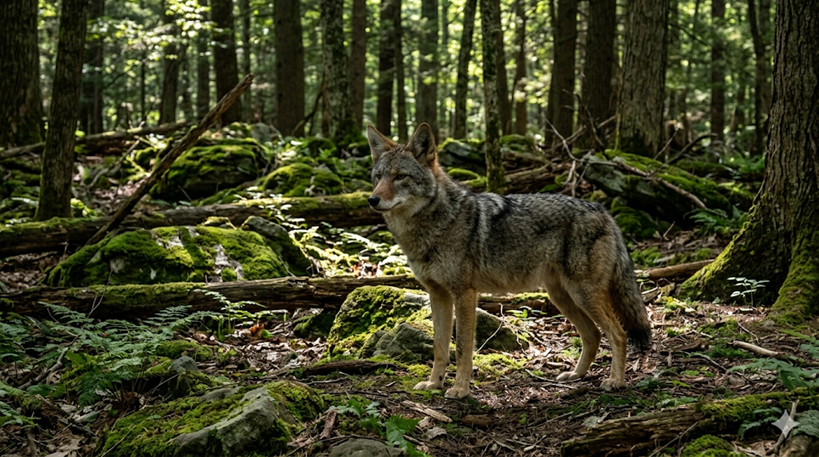
The Eastern Coyote is a unique canid that is significantly larger and more robust than its ancestors from the western plains. Often referred to informally as the "Coywolf," this animal is a genetic blend of Western Coyote, Eastern Wolf, Gray Wolf, and a small amount of domestic dog. This "four-in-one" genetic makeup has created a highly adaptable predator perfectly suited for the dense forests of the Northeast.
Habitat in the ANF
In the Allegheny National Forest, Eastern Coyotes are ubiquitous and highly adaptable. While they prefer the heavy, brushy cover found in clearcuts and younger forest stands, they are also comfortable in deep, mature timber. They are most active along forest edges where the woods meet agricultural land or open meadows—areas that provide a high concentration of prey like rabbits and deer.
Ecology and the "New Wolf" Role
Following the local extinction of gray wolves in the 19th century, the Eastern Coyote moved in to fill the vacant ecological niche. Unlike western coyotes, which primarily target small rodents, the Eastern Coyote has developed social strategies for larger prey. In the ANF, they function as apex predators that help manage the white-tailed deer population; during harsh winters, deer can make up over 60% of their diet.
Identification
The Size: Significantly larger than a western coyote, with Pennsylvania males often weighing between 45 and 55 pounds. They are frequently mistaken for small German Shepherds.
The Tail: They possess a thick, bushy tail that is almost always held in a downward position when running (unlike dogs, whose tails may curl, or wolves, who often hold them straight out).
The Profile: Look for large, erect ears and a long, pointed muzzle. Their legs often feature a distinct black line or marking running down the front of the forelegs.
The Voice: Their vocalizations are a complex mix of deep, wolf-like howls that often break into high-pitched, frantic yips and barks.
The Eastern Coyote is a unique canid that is significantly larger and more robust than its ancestors from the western plains. Often referred to informally as the "Coywolf," this animal is a genetic blend of Western Coyote, Eastern Wolf, Gray Wolf, and a small amount of domestic dog. This "four-in-one" genetic makeup has created a highly adaptable predator perfectly suited for the dense forests of the Northeast.
Habitat in the ANF
In the Allegheny National Forest, Eastern Coyotes are ubiquitous and highly adaptable. While they prefer the heavy, brushy cover found in clearcuts and younger forest stands, they are also comfortable in deep, mature timber. They are most active along forest edges where the woods meet agricultural land or open meadows—areas that provide a high concentration of prey like rabbits and deer.
Ecology and the "New Wolf" Role
Following the local extinction of gray wolves in the 19th century, the Eastern Coyote moved in to fill the vacant ecological niche. Unlike western coyotes, which primarily target small rodents, the Eastern Coyote has developed social strategies for larger prey. In the ANF, they function as apex predators that help manage the white-tailed deer population; during harsh winters, deer can make up over 60% of their diet.
Identification
The Size: Significantly larger than a western coyote, with Pennsylvania males often weighing between 45 and 55 pounds. They are frequently mistaken for small German Shepherds.
The Tail: They possess a thick, bushy tail that is almost always held in a downward position when running (unlike dogs, whose tails may curl, or wolves, who often hold them straight out).
The Profile: Look for large, erect ears and a long, pointed muzzle. Their legs often feature a distinct black line or marking running down the front of the forelegs.
The Voice: Their vocalizations are a complex mix of deep, wolf-like howls that often break into high-pitched, frantic yips and barks.