Fly Agaric
(Amanita muscaria)
⚠️
Caution: Never consume any wild fungi unless you are 100% certain of its identity and have consulted with an expert mycologist. Many toxic species closely resemble edible ones.
Species Description
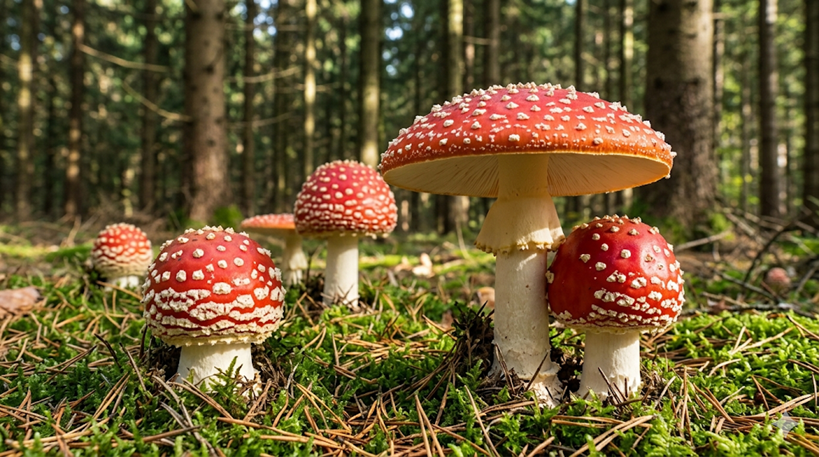
Description: The quintessential "fairy tale" mushroom, the Fly Agaric is the most iconic fungus in the world. While the classic European version is bright red, the variety most common in the Eastern United States—including the Allegheny National Forest—is often a brilliant yellow-orange to peach color, decorated with distinctive white "warts."
Habitat in the ANFIn the Allegheny National Forest, you’ll find the Fly Agaric (specifically the variety guessowii) growing in a symbiotic relationship with both conifers and hardwoods. Look for them near the roots of Pine, Spruce, and Hemlock, as well as Birch and Beech. They are especially prevalent in late summer and autumn, often popping up in the mossy transition zones where the forest floor meets the edge of a trail or a clearing.
Ecology and the Underground Trade: The Fly Agaric is an ectomycorrhizal fungus, meaning its mycelium (the "roots") wraps around the tiny root tips of trees. This is a mutually beneficial partnership: the fungus acts like a massive extension of the tree's root system, scavenging for water and phosphorus in the soil. In exchange, the tree provides the fungus with sugars produced through photosynthesis. Without these mushrooms, the towering trees of the ANF would struggle to grow as large or as healthy.
Identification
The Cap: Usually 3 to 8 inches wide, ranging from a sunny yellow to a deep, reddish-orange toward the center. It is covered in white or cream-colored warts—remnants of a protective "universal veil" that covered the mushroom when it was a tiny button.
The Gills: On the underside, you will find clean, white, crowded gills that are not attached to the stem (free gills).
The Stem and Ring: The stalk is white and sturdy, featuring a prominent, skirt-like ring (annulus) near the top.
The Bulbous Base: At the very bottom of the stem, there is a swollen bulb decorated with shaggy, concentric rings of white scales. This is a critical feature to distinguish it from other yellow mushrooms.
Habitat in the ANFIn the Allegheny National Forest, you’ll find the Fly Agaric (specifically the variety guessowii) growing in a symbiotic relationship with both conifers and hardwoods. Look for them near the roots of Pine, Spruce, and Hemlock, as well as Birch and Beech. They are especially prevalent in late summer and autumn, often popping up in the mossy transition zones where the forest floor meets the edge of a trail or a clearing.
Ecology and the Underground Trade: The Fly Agaric is an ectomycorrhizal fungus, meaning its mycelium (the "roots") wraps around the tiny root tips of trees. This is a mutually beneficial partnership: the fungus acts like a massive extension of the tree's root system, scavenging for water and phosphorus in the soil. In exchange, the tree provides the fungus with sugars produced through photosynthesis. Without these mushrooms, the towering trees of the ANF would struggle to grow as large or as healthy.
Identification
The Cap: Usually 3 to 8 inches wide, ranging from a sunny yellow to a deep, reddish-orange toward the center. It is covered in white or cream-colored warts—remnants of a protective "universal veil" that covered the mushroom when it was a tiny button.
The Gills: On the underside, you will find clean, white, crowded gills that are not attached to the stem (free gills).
The Stem and Ring: The stalk is white and sturdy, featuring a prominent, skirt-like ring (annulus) near the top.
The Bulbous Base: At the very bottom of the stem, there is a swollen bulb decorated with shaggy, concentric rings of white scales. This is a critical feature to distinguish it from other yellow mushrooms.